


For R&D Data Intelligence
Turn fragmented laboratory and experimental data into a searchable, AI-ready knowledge base that helps scientists reuse past work, accelerate development, and power predictive R&D.
The Problem
Your most valuable R&D data exists, but it cannot be consistently found, compared, or used.
01
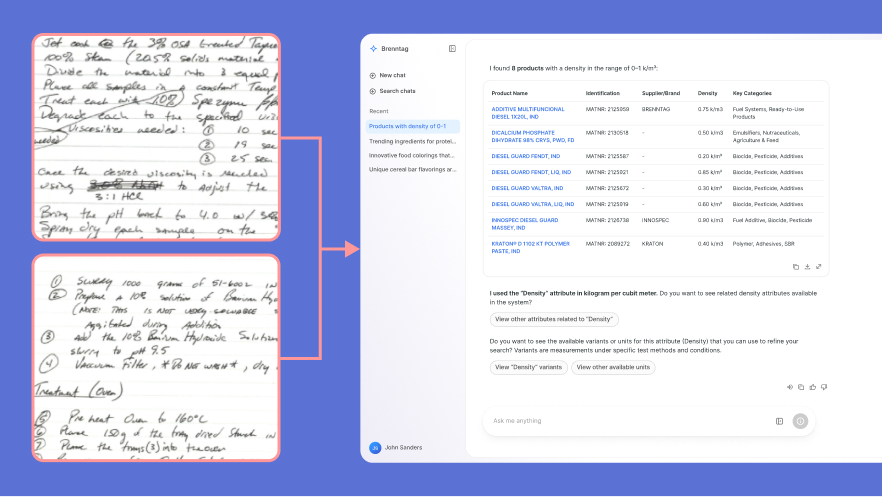
Decades of laboratory knowledge are scattered across handwritten notebooks, scanned documents, spreadsheets, instrument outputs, electronic lab notebooks, LIMS platforms, shared drives, databases, and legacy systems.
02
Each source captures information differently. Material names, units, test methods, experimental parameters, result formats, and terminology vary across systems, laboratories, business units, and individual scientists. The same material may appear under multiple names, and similar experiments may be recorded using entirely different structures.
03
As a result, laboratory data is highly fragmented, inconsistent, and non-standardized. Even when the information has already been digitized, it is often not harmonized enough to search across sources, compare experiments, identify patterns, or generate reliable insights.et.
04
Scientists spend significant time locating prior work, interpreting incompatible records, and determining whether similar experiments have already been conducted. When relevant data cannot be found or compared, teams repeat experiments, consume additional materials and instrument time, and extend development timelines.
05
This lack of structure also prevents organizations from taking full advantage of modern AI and machine learning. Predictive systems require clean, normalized, and connected data. Fragmented laboratory records cannot readily support design of experiments, predictive formulation, performance modeling, or molecular design.
The Solution
Give scientists one place to find, understand, and reuse the organization’s experimental knowledge.
01
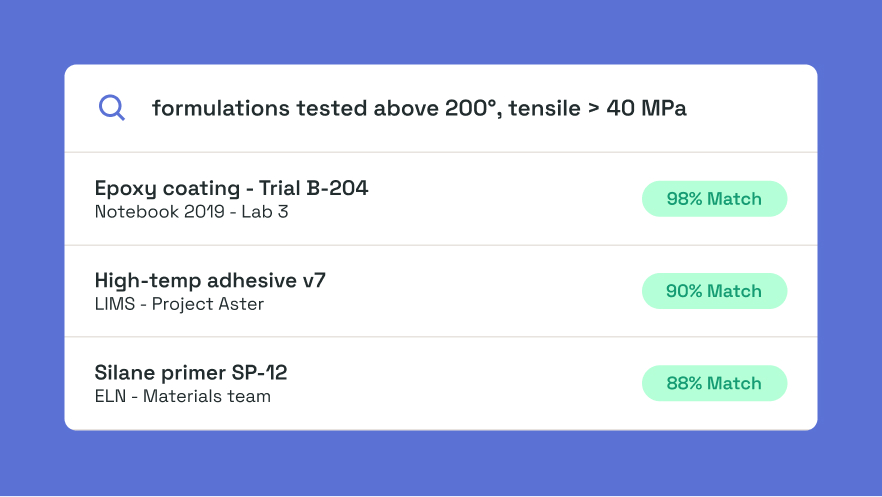
Scientists can search across decades of laboratory data using natural-language questions or technical filters, regardless of where the original information was stored.
02
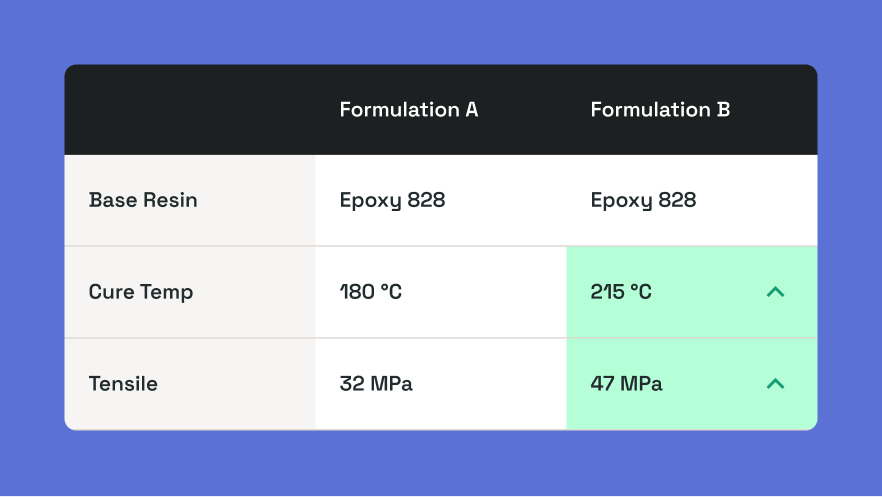
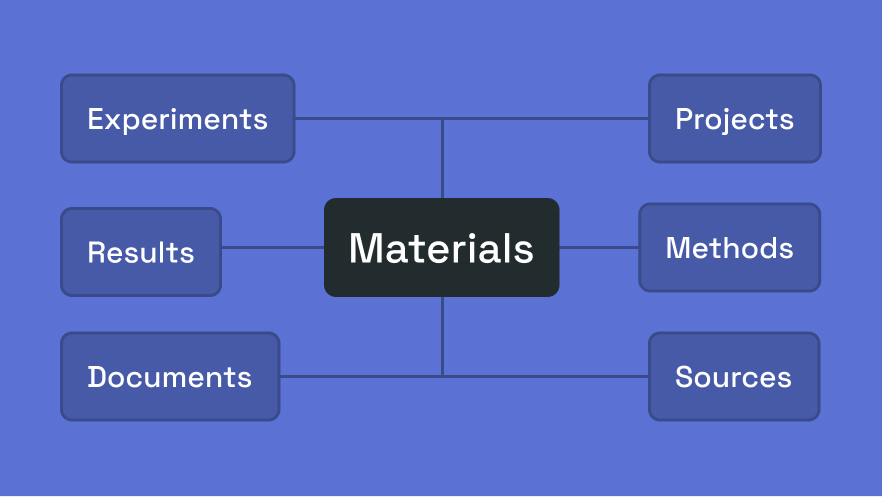
They can quickly find relevant experiments, compare formulations and results, understand which variables influenced performance, and trace every insight back to the original source. Instead of searching notebooks, files, and disconnected systems, researchers work from a unified view of materials, methods, conditions, observations, and outcomes.
03
The result is a governed R&D knowledge base that helps teams avoid repeating past work, make faster experimental decisions, and retain critical knowledge as employees change.
04
Because the underlying data is structured and harmonized, it can also support advanced AI and machine-learning applications, including predictive formulation, design of experiments, performance modeling, and molecular design
05
06
Positive Business Outcomes
Make prior experiments instantly searchable — so scientists move faster, labs stop paying for duplicate runs, and your data is ready for predictive R&D.
01
Faster Access to Prior Work: Scientists can quickly find and compare relevant experiments across systems instead of manually searching files, databases, and notebooks.
02
Lower Experimentation Costs: Better visibility into previous work reduces duplicate experiments, unnecessary material consumption, technician effort, and instrument usage.
03
Predictive R&D at Scale: Clean, harmonized experimental data provides the foundation required for predictive formulation, design of experiments, performance modeling, and molecular design.
How We Do It

Step 1
Ingest Laboratory Data: Knowde connects to handwritten notebook scans, PDFs, spreadsheets, shared drives, instrument exports, ELNs, LIMS platforms, databases, and other laboratory or enterprise systems.
Step 2
Extract Experimental Information: Knowde AI identifies and extracts materials, formulations, quantities, process parameters, test conditions, methods, observations, results, dates, authors, and project context.
Step 3
Harmonize and Standardize: Material names, terminology, units, properties, methods, parameters, and result formats are mapped to a common taxonomy and data model so information can be compared across systems, laboratories, and time periods.
Step 4
Connect and Validate Records: Related materials, experiments, projects, documents, and source records are linked. Validation workflows help confirm extracted information and preserve traceability to the original source.
Step 5
Deliver the Data for Search and AI: The structured data is loaded into a governed R&D database that supports natural-language search, technical filtering, and cross-experiment comparison. It can also be integrated into analytics platforms and predictive AI environments.
Step 6
Return on Investment

25-40% reduction in duplicated experiments within 6-12 months.

20-35% faster time from experiment initiation to insight.

10-20% increase in experiments per scientist per quarter.

>90% search success rate so scientists find relevant prior work in under 2 queries.


